
Beyond the HRT Conjecture: Counterexamples and New Questions
Abstract
In 1996, C. Heil, J. Ramanathan, and P. Topiwala conjectured that any finite collection of distinct time-frequency shifts — translations and modulations — of a nonzero square-integrable function is linearly independent. In August 2026, Faulhuber, Petersen, van Velthoven, and Voigtlaender constructed a counterexample consisting of twelve time-frequency shifts of a Schwartz function. Shortly afterward, Oussa and, independently, Dai, Deng, Shi, Wu, and Yang constructed counterexamples involving four-point configurations and Schwartz functions. Since any three distinct time-frequency shifts of a nonzero square-integrable function are linearly independent, these constructions settle the HRT conjecture in the negative with counterexamples of the smallest possible cardinality. All three constructions were developed with the assistance of large language models (LLMs).
Nevertheless, many questions remain open. For a fixed nonzero square-integrable function and an integer n≥4, can we characterize the configurations of n distinct points in the time-frequency plane that yield linear dependence? How large is the set of such configurations?
In this talk, I will give an overview of the conjecture and discuss these questions in the context of the known four-point counterexamples. Finally, I will present recent joint work with Shuang Guan computing the Lebesgue and Hausdorff measures of the set of four-point configurations that yield linear dependence for a fixed nonzero square-integrable function.
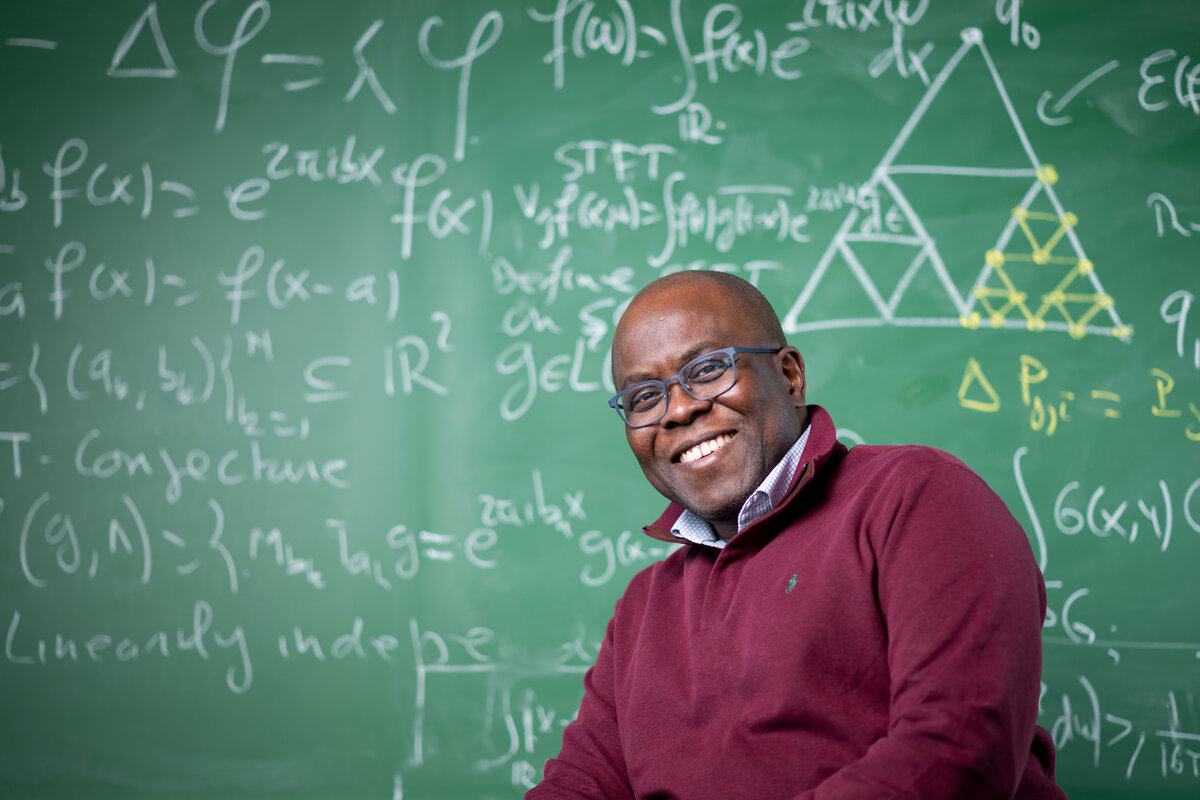
Professor Kasso Okoudjou is the Robinson Professor in Mathematics and Chair of the Department of Mathematics at Tufts University. He is a Fellow of the American Mathematical Society (class of 2024) and previously served as a Professor of Mathematics at the University of Maryland and as a Martin Luther King Jr. Visiting Professor at MIT.
His research spans pure, applied, and numerical harmonic analysis, particularly wavelets, frame theory, time-frequency analysis, and applications to nonlinear partial differential equations. He also studies spectral analysis on fractals and graphs and its applications to data science. His interests in mathematics education include active learning and broadening the participation of underrepresented minorities in undergraduate mathematics research.