
How Singular Can a Singularity Be?
About the Event
The FSU Women in Math departmental lecture series is an annual event aimed at promoting the achievements of women in mathematics and fostering an inclusive community within the field. Held each March, the series features a one-day program that includes a lunch with graduate students, AWM Chapter members, female faculty and postdocs, followed by a colloquium lecture delivered by a distinguished female mathematician. The event provides a platform for networking, mentorship, and inspiring discussions on current mathematical research and gender diversity in the mathematical sciences.
Abstract
Can we attach a number to a singularity that measures how far it is from being smooth? Starting with pictures of curves and surfaces defined by polynomial equations, I will introduce two related ways to do this: one using integration over the complex numbers, the other using arithmetic modulo a prime. We will then ask which cone singularities are “worst” among those of a fixed degree.
This question leads to a surprising connection with a classical geometric problem: how many lines can lie on a smooth surface? The same equations that produce extremal cone singularities also define smooth projective surfaces with remarkable configurations of lines. We will explore this connection through the classical 27 lines on a cubic surface. We conclude with a recent answer to this question from joint work with Janet Page and Tim Ryan.
The talk will emphasize pictures and concrete examples. No background in algebraic geometry will be assumed.
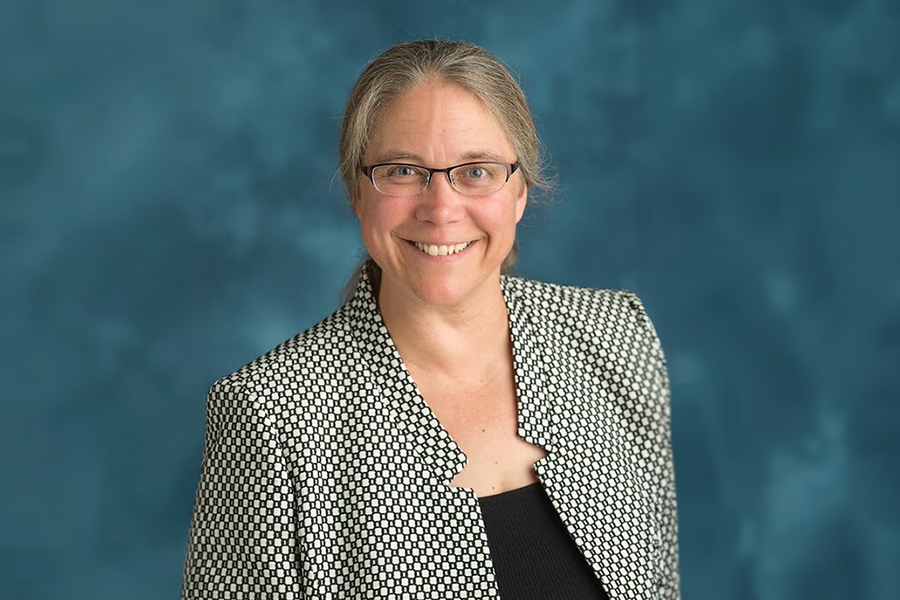
Professor Karen E. Smith is the William Fulton Distinguished University Professor of Mathematics and chair of the Department of Mathematics at the University of Michigan. Her research lies at the interface of commutative algebra and algebraic geometry, with particular emphasis on using methods from positive characteristic to address questions about algebraic varieties over fields of characteristic zero.
Professor Smith has been a leading figure in developing and applying Frobenius methods in algebraic geometry. Her work helped establish deep connections between singularities detected through reduction to characteristic p and rational singularities and other classes of singularities arising in birational geometry. She also made fundamental contributions to understanding how Frobenius splitting and related techniques can be used to study global geometric properties of projective varieties, including positivity and projective embeddings.
Another important direction of her work concerns multiplier ideals and test ideals. She has contributed to the development of asymptotic multiplier ideals in characteristic zero and their positive-characteristic analogues, test ideals, as well as associated invariants such as jumping numbers. These ideas have become important tools connecting commutative algebra, singularity theory, and birational geometry.
Professor Smith's contributions have been recognized with numerous honors, including the Ruth Lyttle Satter Prize in Mathematics from the American Mathematical Society and the AWM–AMS Noether Lecture. She was elected to the National Academy of Sciences and the American Academy of Arts and Sciences, and she delivered the AMS Colloquium Lectures in 2022.
Women in Math Lunch: Oct 16, 11:00 am -- 1:00 pm, Globe Dining Room
Women in Math Lecture: Oct 16, 3:05 pm -- 4:00 pm, LOV 101
This event is supported by the Vice President for Research, Stacey Patterson, the dean of the College of Arts and Sciences, Sam Huckaba, and the Department of Mathematics at Florida State University.